
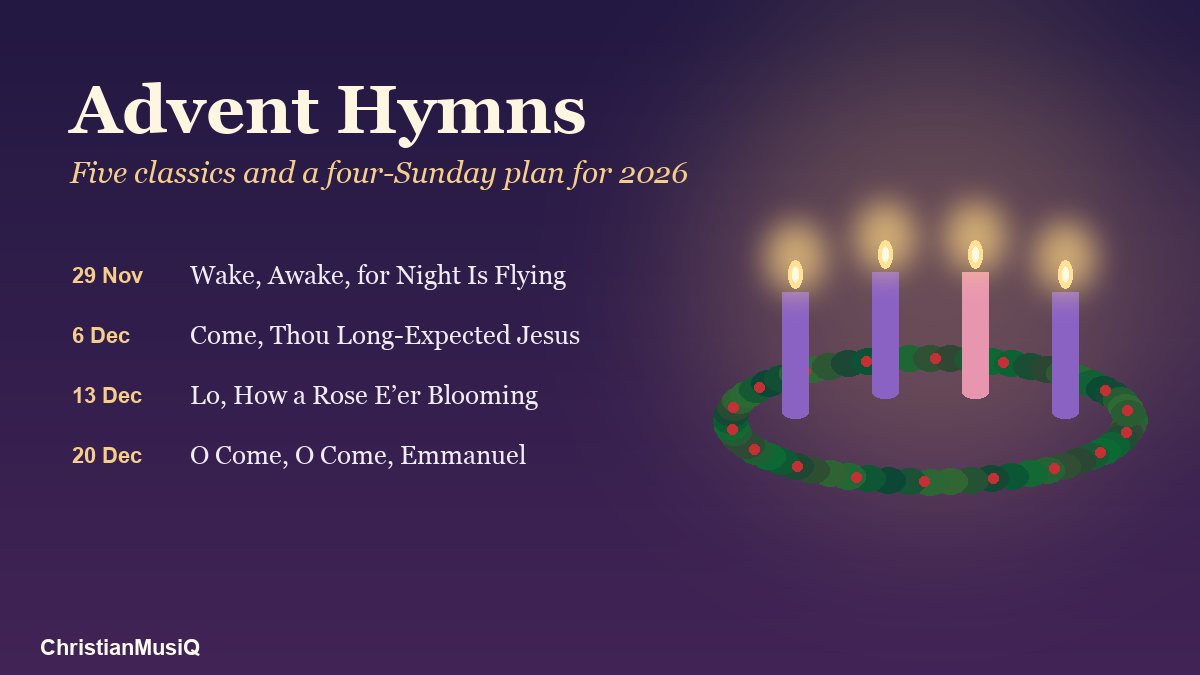
Advent is the one season where the oldest music in the hymnbook is also the most useful. The best Advent hymns are between roughly 280 and 500 years old, they are in the public domain, and each one has a clear job: waiting, watching, longing or promise. This guide gives you five of them, the real story behind each, and a simple plan for the four Sundays of Advent 2026.
Quick Answer
Advent 2026 begins on Sunday 29 November and runs through the fourth Sunday, 20 December, to Christmas Eve on Thursday 24 December. Five hymns carry the season well: Wake, Awake, for Night Is Flying (Philipp Nicolai, 1599), Come, Thou Long-Expected Jesus (Charles Wesley, 1744), Lo, How a Rose E’er Blooming (German, printed 1599), O Come, O Come, Emmanuel (Latin text printed 1710) and Savior of the Nations, Come (Martin Luther, 1523–24). A plan that works for most congregations is to open with the hymn about watching and finish with the hymn built on the O Antiphons.
Why Advent Needs Its Own Hymns
Christmas carols celebrate a birth that has happened. Advent hymns do something different: they sit in the waiting. They are written in the imperative (“come”, “wake”, “save”) and they borrow their pictures from the prophets, especially Isaiah. A congregation that sings carols from the first of December skips that waiting. A congregation that sings these five hymns first hears the carols differently when Christmas Eve arrives.
There is also a practical reason. Advent hymns are almost all old enough that the words and the tunes are free to print, project and stream in most countries, although modern arrangements and recordings are separate works and may still be protected. If you are planning a December service, our worship song credit and licensing checklist and the guide to which Christmas carols are public domain cover the paperwork.
1. Wake, Awake, for Night Is Flying
Philipp Nicolai wrote “Wachet auf, ruft uns die Stimme” in 1598, while plague was killing people in the town of Unna, where he was serving as a preacher. He published it with its tune in 1599. The text retells the parable of the ten bridesmaids in Matthew 25:1–13 and adds images from Revelation, including the twelve gates of pearl. Nicolai also hid a tribute inside it: the first letters of its three stanzas, read in reverse, spell the initials of “Graf zu Waldeck”, a former pupil, Count Wilhelm Ernst of Waldeck, who had died of the plague at fourteen.
Catherine Winkworth’s 1858 English translation, “Wake, Awake, for Night Is Flying”, is the one most English hymnals use. Johann Sebastian Bach built his chorale cantata BWV 140 (1731) on the hymn, and the Netherlands Bach Society’s free recording above shows the whole piece. For a congregation, the hymn works best as a first-Sunday opener because its message is simply “be ready”.
2. Come, Thou Long-Expected Jesus
Charles Wesley published this hymn in 1744 in Hymns for the Nativity of our Lord. It is a prayer rather than a story: it asks Christ to be born in the believer and to rule the heart. Its opening draws on Haggai 2:7, “the desire of all nations”, and he wrote with the poverty and class divide of eighteenth-century England in view.
The tune is a choice, and it matters. The early German tune Stuttgart is the traditional partner. The Welsh tune Hyfrydol, by Rowland Hugh Prichard, is the one many congregations know from “Love Divine, All Loves Excelling”, and in the United Kingdom the hymn is often sung to Stainer’s “Cross of Jesus”. If your people already know Hyfrydol, use it; learning a hymn and a new tune in the same week is the quickest way to get a silent congregation.
3. Lo, How a Rose E’er Blooming
“Es ist ein Ros entsprungen” first appeared in print in the Speyer hymnbook (Cologne, 1599). Its author is unknown, and the oldest source is a manuscript from a Carthusian monastery in Trier. The familiar harmony is by Michael Praetorius, 1609, and Johannes Brahms later wrote a chorale prelude on it (1896). The English words most people sing are Theodore Baker’s translation of 1894.
The rose is Isaiah’s shoot from the stem of Jesse (Isaiah 11:1), the family tree of David. In the German original the rose is Mary; in Baker’s English the rose is the child. The hymn has only a few short stanzas, which makes it a gentle option for the third Sunday, when the mood in many churches turns from watching to quiet joy.
4. O Come, O Come, Emmanuel
The best-known Advent hymn is also the one with the most myths. Many books say it is a medieval hymn. In fact the Latin metrical text, “Veni, veni, Emmanuel”, first appears in print in the Cologne hymnal Psalteriolum Cantionum Catholicarum in 1710. What is genuinely ancient is its source: the O Antiphons, short chants sung before the Magnificat at Vespers from 17 to 23 December. Each begins with a title for Christ taken from the prophets, such as Wisdom, Root of Jesse and Key of David.
John Mason Neale published the first English version in 1851 (“Draw nigh, draw nigh, Emmanuel”) and revised it twice, the last time for Hymns Ancient and Modern in 1861, when it became “O come, O come, Emmanuel”. The tune, Veni Emmanuel, was first joined to the words in Thomas Helmore’s Hymnal Noted (1851), which credited a French missal in Lisbon. In 1966 the musicologist Mary Berry found the melody in a fifteenth-century French processional in the National Library of France, though no one knows whether it was ever sung to these words before 1851.
Because the O Antiphons are sung from 17 December, the fourth Sunday (20 December in 2026) is the natural place for this hymn. Singing a verse unaccompanied, in the manner of plainchant, fits its history.
5. Savior of the Nations, Come
Martin Luther wrote “Nun komm, der Heiden Heiland” possibly for Advent 1523. It paraphrases a Latin hymn by Ambrose of Milan, “Veni redemptor gentium”, closely, keeping to the themes of the fourth-century original. The chorale was printed in the Erfurt Enchiridion in 1524, and for centuries it was the hymn for the first Sunday of Advent in Lutheran Germany. Bach used it in two church cantatas and several organ settings. The English version “Savior of the Nations, Come” is by William Morton Reynolds (1851).
It is the plainest of the five and the least known to modern congregations, which is exactly why a church that wants a first-Sunday hymn with real weight might choose it over Wachet auf.
A Four-Sunday Plan for Advent 2026
- Sunday 1, 29 November: Wake, Awake, for Night Is Flying (or Savior of the Nations, Come). Theme: watch and be ready.
- Sunday 2, 6 December: Come, Thou Long-Expected Jesus. Theme: longing and prayer.
- Sunday 3, 13 December: Lo, How a Rose E’er Blooming. Theme: Isaiah’s promise.
- Sunday 4, 20 December: O Come, O Come, Emmanuel. Theme: the week of the O Antiphons.
Three practical tips for the person choosing the songs.
Teach one new item per week, not three. Pair an unfamiliar hymn with a well-known tune (Hyfrydol is the safest example).
Hold the carols back. Many congregations keep “Joy to the World” and “Silent Night” for Christmas Eve and the days after. Our pages on Joy to the World and Silent Night are ready for that week.
Mix old and new deliberately. A modern song about waiting can sit next to an old hymn, but check the licence for the arrangement. For a wider approach to building a service, read how to build a worship set and worship planning for small churches.
If You Like This
Other hymns with documented histories on this site: In the Garden, How Firm a Foundation and Be Thou My Vision. For the hymn’s own song page, see O Come, O Come, Emmanuel, and for the reason old hymns keep working, read why ancient hymns still matter.
FAQ
When does Advent start in 2026?
Advent begins on Sunday 29 November 2026, the fourth Sunday before Christmas, and runs to Christmas Eve on 24 December.
What are the most popular Advent hymns?
“O Come, O Come, Emmanuel”, “Come, Thou Long-Expected Jesus”, “Lo, How a Rose E’er Blooming”, “Wake, Awake, for Night Is Flying” and “Savior of the Nations, Come” are standard in hymnals across denominations.
Is “O Come, O Come, Emmanuel” a medieval hymn?
Not as a hymn. The Latin metrical text first appears in print in 1710. The antiphons it is based on, the O Antiphons, are much older and are sung from 17 to 23 December.
Are Advent hymns in the public domain?
The original texts, the old translations (such as Neale 1851 and Baker 1894) and the traditional tunes are in the public domain. New arrangements, recordings and translations may be protected, so check before you project or stream them.
Why are Advent hymns in a minor key?
Many Advent tunes, including Veni Emmanuel, are modal or minor because the season is about longing. Not all of them are: Hyfrydol, a common tune for “Come, Thou Long-Expected Jesus”, is in a major key.
Sources
Wikipedia: O come, O come, Emmanuel
Wikipedia: Come, Thou Long Expected Jesus
Wikipedia: Wachet auf, ruft uns die Stimme
Wikipedia: Nun komm, der Heiden Heiland
Wikipedia: Lo, How a Rose E’er Blooming