
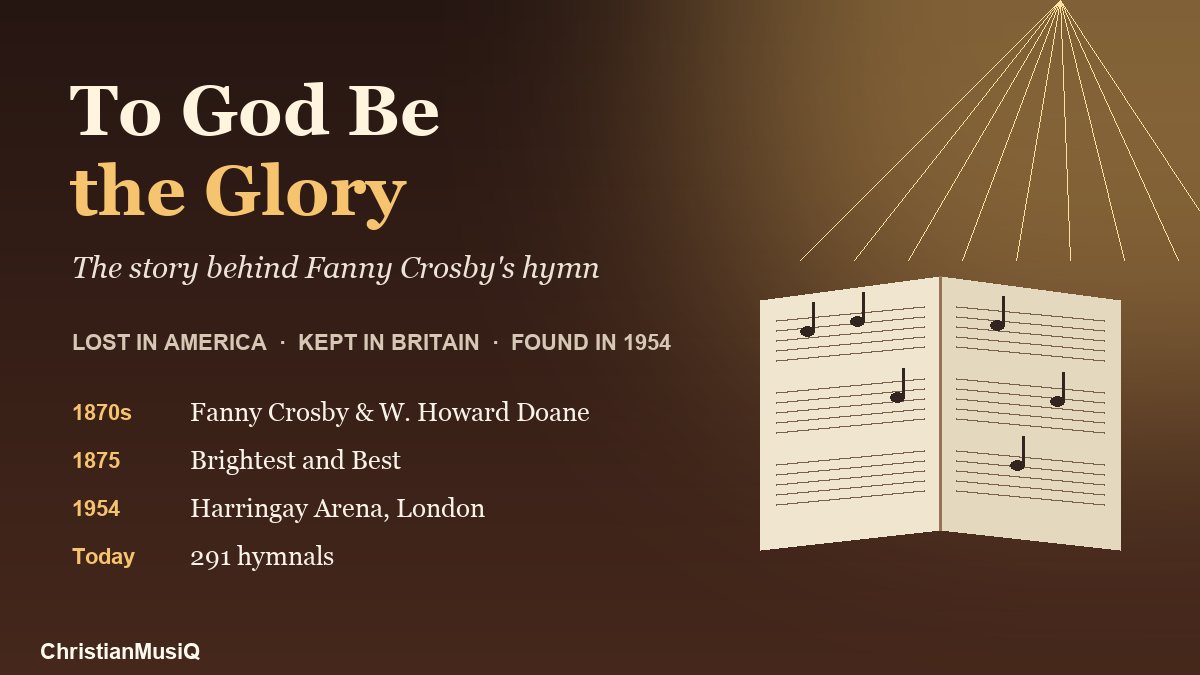
“To God Be the Glory” is one of the few gospel hymns that nearly every English-speaking church tradition sings, from Baptist and Methodist congregations to Anglican cathedrals and Indian city churches. Yet for most of its first eighty years it was almost unknown in the country where it was written. The story of how a blind New York poet and a Cincinnati factory owner wrote it, how Britain kept it alive, and how a 1954 crusade in London brought it home to America is one of the best “lost and found” stories in hymn history.
Quick Answer
“To God Be the Glory” was written by Fanny Crosby (1820–1915) with a tune by William Howard Doane (1832–1915). It was printed in Robert Lowry and Doane’s collection Brightest and Best in 1875, under the heading “Praise for Redemption”. Ira Sankey carried it into his British songbooks, where it stayed in use, while it faded in the United States. In 1954 Billy Graham’s song leader Cliff Barrows added it to the songbook for the London crusade at Harringay Arena, made it the crusade’s theme hymn and brought it back to America that August in Nashville. Today Hymnary.org lists it in 291 hymnals, and both the words and the tune are in the public domain.
The Writers: Fanny Crosby and W. Howard Doane
Frances Jane Crosby was born on 24 March 1820 in Brewster, New York, and lost her sight at six weeks old. She entered the New York Institution for the Blind at 15 and later taught there. Over her life she wrote more than 8,000 hymns and gospel songs, so many that she used close to 200 pen names to stop hymnals looking as if they were filled by one writer. Her best-known texts include “Blessed Assurance”, “Pass Me Not, O Gentle Saviour” and “Rescue the Perishing”. You can read about one of them on our Blessed Assurance song page.
William Howard Doane was an unlikely hymn composer. He ran J. A. Fay & Company, a Cincinnati maker of woodworking machinery, and more than seventy patents were registered in his name. He was also a Baptist choir director who composed around 2,300 pieces and set something like 1,500 of Crosby’s poems to music. The two first met in New York in 1867, and they died in the same year, 1915: Crosby on 12 February at the age of 94, Doane on 24 December.
Crosby described how they worked in her 1906 autobiography, Memories of Eighty Years. Sometimes a subject was handed to her and a tune written afterwards; at other times a melody was played to her and she found words to fit it. In a good hymn, she said, words and music must agree “not only in number of syllables, but in subject matter and especially accent.” Nobody recorded which came first for “To God Be the Glory”, but the fit she describes is exactly what makes it work.
When Was It Written? The Dates Do Not Agree
Most hymnals give 1875, the year of Brightest and Best, and the Hymnology Archive treats that book as the first printing. Wikipedia suggests it was written around 1872. C. Michael Hawn, writing for the United Methodist Discipleship Ministries “History of Hymns” series, goes further and says it already appeared in Doane’s Songs of Devotion in 1870. The honest answer is that it was written in the early 1870s and was in print by 1875 at the latest. If you introduce it in church, “written in the 1870s” is safe.
How the Hymn Was Lost and Found
Ira Sankey, the singer who travelled with the evangelist Dwight L. Moody, put the hymn into his British collection Sacred Songs and Solos, but not into the American Gospel Hymns series. As a result it was sung in Britain for decades while most American hymnals ignored it.
Cliff Barrows told the next part himself in Crusade Hymn Stories (1967). He heard the hymn in Britain in 1952. When the Graham team was compiling a songbook for the 1954 London crusade, someone suggested it and he agreed “because of its strong text of praise and its attractive melody.” Crowds at Harringay Arena sang it with such energy that Billy Graham asked for it again and again, and in the closing weeks it became the crusade’s theme hymn, sung almost every night. Barrows then used it at the Nashville crusade in August 1954, and from there it spread through American churches and into most modern hymnals.
Hymnologist William J. Reynolds summed it up in 1964: it was “most extraordinary that this long-forgotten American gospel song should have been imported from England.”
What the Hymn Teaches
The first stanza and the refrain show why it has lasted. The text dates from the 1870s and is in the public domain:
“To God be the glory, great things He hath done; / So loved He the world that He gave us His Son, / Who yielded His life an atonement for sin, / And opened the life gate that all may go in.”
“Praise the Lord, praise the Lord, let the earth hear His voice! / Praise the Lord, praise the Lord, let the people rejoice! / O come to the Father, through Jesus the Son, / And give Him the glory, great things He hath done.”
Three things stand out.
It is about God, not the singer. Many gospel songs of the period are personal testimony. This one is, in Carl Daw’s phrase, “a remarkably objective celebration of God’s saving work in Jesus Christ.” The word “I” never appears.
It is full of Scripture. The second line restates John 3:16. The “life gate” possibly points to the narrow gate of Matthew 7:13–14, and “come to the Father, through Jesus the Son” echoes John 14:6. The title idea runs through Galatians 1:4–5, “to whom be glory for ever and ever”, and the phrase “great things he hath done” is the King James wording of 1 Samuel 12:24.
It moves from the cross to the end of time. Stanza 1 is the gift of the Son, stanza 2 the forgiveness offered to “the vilest offender who truly believes”, and stanza 3 the future, when “purer, and higher, and greater will be our wonder, our rapture, when Jesus we see.”
Leading “To God Be the Glory” Today
Use it to open or to close. Its fanfare-like refrain makes it a natural call to worship or a final song of praise. It suits thanksgiving services in particular: “great things He hath done” is the whole theme of a harvest or Thanksgiving Sunday, and US Thanksgiving falls on 26 November this year. For ideas on what to place around it, see our guide to building a worship set that flows.
Let the refrain breathe. Each “Praise the Lord” is a short shout of praise. A small choir or one side of the room can sing the first “Praise the Lord” and everyone answers with the second, which helps a congregation that does not yet know the tune.
Pick a comfortable key. The melody climbs in the refrain, so check the range in your hymnal or chord chart and lower it if your congregation struggles with the top notes. Simple guitar or piano accompaniment is enough; our beginner’s guide to worship chords covers the basics.
Tell the story in one sentence. Before singing, mention that the hymn was nearly forgotten in America until a crusade in London brought it back. Small stories like this, as with “In the Garden” and “How Firm a Foundation”, help people sing old words with fresh attention. We make the wider case in why the old hymns still matter.
Is “To God Be the Glory” in the Public Domain?
Yes. Crosby’s words and Doane’s tune were published by 1875, long before the US public-domain cut-off, which in 2026 covers works first published in 1930 or earlier. That covers the original hymn only. Modern arrangements, added choruses, translations and specific recordings can still be under copyright, so check the credits on any chart or backing track you use. Our worship song credit and licensing checklist walks through the questions. This is general information, not legal advice.
Do not confuse it with Andraé Crouch’s gospel song “My Tribute”, which is often called “To God Be the Glory”. That is a different, modern song and is still under copyright.
FAQ
Who wrote “To God Be the Glory”?
Fanny Crosby wrote the words and William Howard Doane wrote the tune, which is also called TO GOD BE THE GLORY.
When was “To God Be the Glory” written?
In the early 1870s. It was printed in Brightest and Best in 1875; one hymnologist dates an appearance to Doane’s Songs of Devotion in 1870.
Who made “To God Be the Glory” popular?
Ira Sankey kept it in use in Britain, and Cliff Barrows, Billy Graham’s song leader, made it famous worldwide after using it as the theme hymn of the 1954 London crusade and then in Nashville that August.
What Bible verses is “To God Be the Glory” based on?
It draws on John 3:16, Galatians 1:4–5, Matthew 7:13–14, John 14:6 and the phrase “great things he hath done” from 1 Samuel 12:24.
How many verses does “To God Be the Glory” have?
Three stanzas, each followed by the “Praise the Lord” refrain.
Sources
Hymnology Archive: To God be the glory
Discipleship Ministries: History of Hymns, To God Be the Glory
Hymnary.org: To God be the glory, great things He hath done