
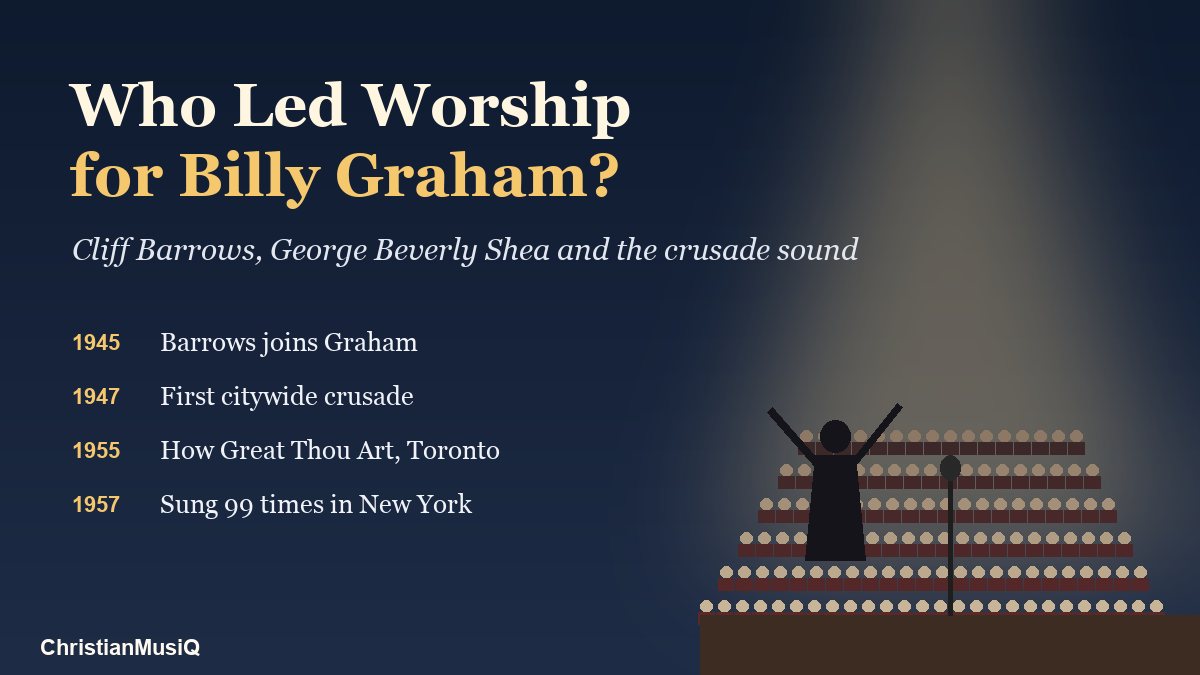
If you watched a Billy Graham crusade on television, two other men were almost always on the platform with him. One stood in front of a choir of thousands with his arms moving in wide, simple beats. The other stepped to the microphone just before the sermon and sang a single hymn in a deep bass-baritone. Their names were Cliff Barrows and George Beverly Shea, and between them they shaped how millions of people heard congregational song in the second half of the twentieth century.
Quick Answer
Billy Graham’s worship leader was Cliff Barrows (1923–2016). He was the music and program director of the Billy Graham Evangelistic Association (BGEA) for more than sixty years, led the congregational singing and the volunteer crusade choirs, and hosted the weekly Hour of Decision radio programme. The crusade soloist was George Beverly “Bev” Shea (1909–2013), the bass-baritone who made “How Great Thou Art” famous. Pianist Tedd Smith joined them in 1950, and organists Don Hustad and John Innes added accompaniment over the years.
Cliff Barrows: The Song Leader
Clifford Burton Barrows was born on 6 April 1923 in Ceres, California. He graduated from Bob Jones University in 1944 with a degree in sacred music and was ordained as a Baptist minister the same year. In 1945, while on honeymoon in western North Carolina with his wife Billie, he met a young evangelist called Billy Graham. Barrows joined Graham at a rally in Asheville and stayed with him for the rest of his life.
His job title grew over the decades: crusade song leader and choir director, platform host, and later director of the association’s radio and television programming. For more than sixty years he also hosted the Hour of Decision, the weekly broadcast that carried Graham’s preaching around the world. When Barrows died on 15 November 2016, aged 93, Graham said there “wouldn’t be a Billy Graham Evangelistic Association in the way it is today without him.”
Church musicians paid him the highest compliment. Mike Harland, then LifeWay Worship Resources director, called Barrows “the Father of every one of us who aspire to lead the church in singing the song of faith.” Barrows was inducted into the Gospel Music Hall of Fame in 1988 and the Religious Broadcasting Hall of Fame in 1996.
George Beverly Shea: The Voice
George Beverly Shea was born on 1 February 1909 in Winchester, Ontario, Canada, the son of a Wesleyan Methodist minister. He sang first in his father’s church choir, then with the Houghton College Glee Club in New York, and spent nine years as an insurance clerk in New York City before radio work took over. At Moody Bible Institute’s station WMBI in Chicago he sang, announced and planned programmes, and on the network show Club Time an advertising agency added “George” to his name because listeners were confused by a man called Beverly.
His link with Graham began on Songs in the Night, a Sunday-evening radio hour broadcast from the basement of Graham’s small church in Western Springs, Illinois, in 1943–44. Graham had heard Shea on the radio and asked him to sing. In 1947 Shea sang at Graham’s first citywide crusade in Charlotte, North Carolina, and he kept singing at crusades for the rest of Graham’s ministry.
Shea also wrote music. At 23 he found a poem by Rhea F. Miller that his mother had left on the family piano, sat down and composed the tune for “I’d Rather Have Jesus”. It became his signature solo. He recorded more than 70 albums, received ten Grammy nominations, won a Grammy for the 1965 album Southland Favorites with the Anita Kerr Quartet, and was given a Lifetime Achievement Grammy in 2011. He died on 16 April 2013, aged 104. Because the crusades drew such large crowds, Shea is often said to have sung live to more people than any other singer in history.
The Songs the Crusade Team Made Famous
“How Great Thou Art.” The hymn began as Carl Boberg’s Swedish poem “O store Gud” in 1885 and reached English through missionary Stuart K. Hine. Shea later described how, during the 1954 London crusade, a publisher’s representative handed him a four-page leaflet with the hymn in English and Russian. The team first sang it at the 1955 Toronto crusade, with Barrows and the choir joining the refrains. Shea wrote that in the 1957 New York meetings “the choir joined me in singing it ninety-nine times!” Today it regularly appears near the top of favourite-hymn polls. Read more on our How Great Thou Art song page.
“To God Be the Glory.” Barrows heard this 1870s Fanny Crosby hymn in Britain, put it in the 1954 London songbook, made it the theme hymn of that crusade and brought it back to America. We tell that story in full in To God Be the Glory: The Story Behind Fanny Crosby’s Hymn.
“Just As I Am.” Graham himself came to faith in 1934 at a revival in Charlotte led by Mordecai Ham, where this Charlotte Elliott hymn was sung as the altar call. It became the invitation hymn of his crusades, sung while people walked forward, and he used its title for his 1997 autobiography.
“I’d Rather Have Jesus.” Shea’s own tune, sung as a solo for decades, gave the crusades a personal testimony in song.
What Their Partnership Teaches Worship Leaders Today
The Graham team worked in arenas and stadiums, but the habits behind it fit a church of fifty people just as well.
Serve the preaching. Barrows saw himself as the person who got a crowd ready to listen, not as a performer. Harland said that whatever the relationship between preacher and song leader can be, “that’s what we all saw” between Barrows and Graham. Planning songs that set up the sermon’s theme is still the best place to start; our guide to building a worship set that flows shows how.
Choose songs a crowd can actually sing. Barrows picked “To God Be the Glory” for its strong text of praise and its attractive melody. Clear words and a tune ordinary people can carry beat novelty every time, which is also the argument of our piece on why the old hymns still matter.
Repeat what works. Singing “How Great Thou Art” ninety-nine times in one campaign sounds excessive, yet that repetition is why a whole generation learned the hymn by heart. A small, stable song list helps a congregation sing with confidence.
Build a team that lasts. Barrows and Shea served alongside Graham for more than sixty years. Many churches now struggle to find and keep musicians, as we reported in the 2026 worship leader shortage study. Investing in volunteers, as the crusades did with their huge local choirs, is part of the answer. For practical steps on a smaller scale, see how to lead worship in a small church.
FAQ
Who was Billy Graham’s song leader?
Cliff Barrows. He led the congregational singing and choirs at Graham’s crusades from the 1940s onward and was the association’s music and program director for more than sixty years.
Who sang at Billy Graham crusades?
George Beverly Shea was the main soloist for more than half a century. Guest artists also sang at many crusades over the years, but Shea was the constant voice.
Who sang “How Great Thou Art” at Billy Graham crusades?
George Beverly Shea, with Cliff Barrows leading the choir on the refrains. They first used it in Toronto in 1955 and sang it ninety-nine times during the 1957 New York crusade.
What hymn was sung at the end of Billy Graham crusades?
“Just As I Am”, the hymn sung at the meeting where Graham himself responded in 1934, was the usual invitation hymn.
Who played the piano for Billy Graham?
Tedd Smith joined the crusade team as pianist in 1950. Don Hustad and John Innes played the organ over the years.
Sources
Baptist Press: Billy Graham Crusades’ Cliff Barrows dies at 93
Billy Graham Evangelistic Association: George Beverly Shea
Hymnology Archive: How Great Thou Art