
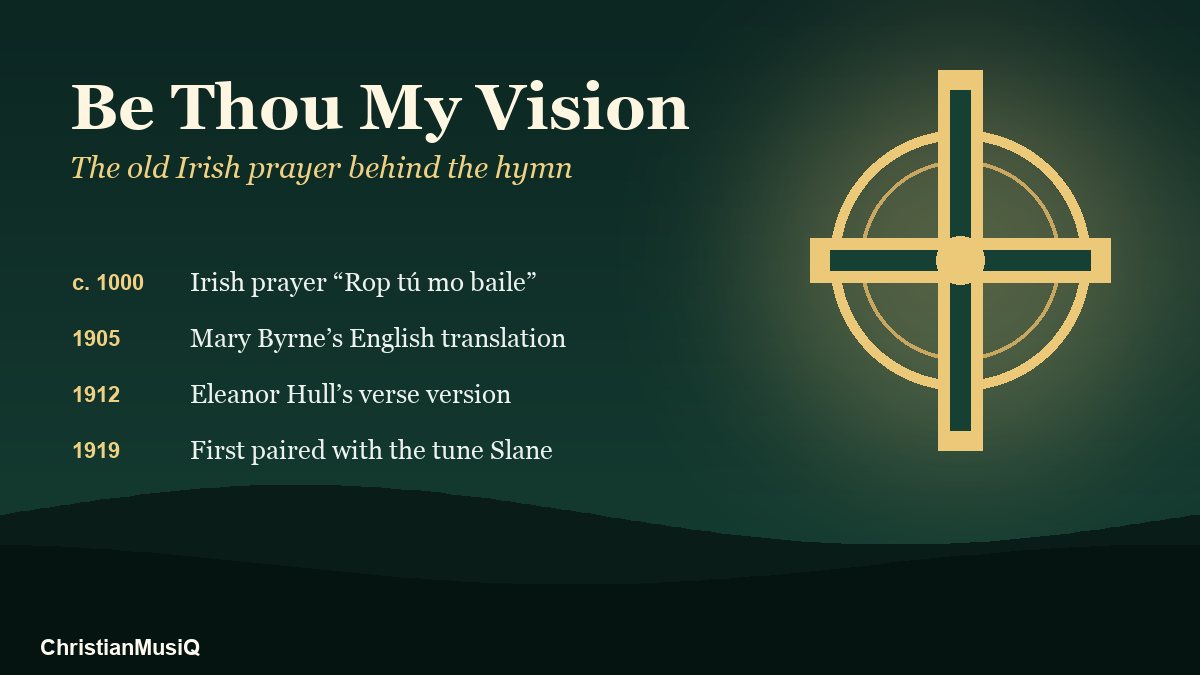
Few hymns travel as far back as “Be Thou My Vision”. The words you sing in church today come from a prayer written in Irish roughly a thousand years ago, translated into English in 1905, turned into verse in 1912, and married to an Irish folk tune only in 1919. Each step has a named person and a printed source, which makes it one of the best-documented stories in the hymnbook.
Quick Answer
“Be Thou My Vision” is a traditional Irish hymn. The text is based on a Middle Irish prayer, Rop tú mo baile, that has sometimes been attributed to St Dallán Forgaill (sixth century), although scholars date the language to the late tenth or eleventh century. Mary Elizabeth Byrne translated the prayer into English prose in 1905, Eleanor Hull versified it in 1912, and the hymn is usually sung to the Irish tune Slane, first paired with the words in 1919. The text and the tune are both in the public domain.
A Prayer of Protection, Not a Song
The original is a lorica, a type of early Irish prayer asking God for protection. Instead of asking for a safe journey or a good harvest, the speaker asks God to be everything: vision, wisdom, word, father, shelter and stronghold. The imagery is a monastery’s idea of a soldier. God is the “High King of Heaven”, the speaker’s “battle-shield” and “sword”. That language echoes Paul’s “shield of faith” and “sword of the Spirit” in Ephesians 6, and it also reflects a world of clan chieftains, where a king protected the people who swore loyalty to him.
The Old Irish poem is a plain list of requests. It begins with the line that gives the hymn its title:
Rop tú mo baile, a Choimdiu cride — “Be thou my vision, O Lord of my heart.”
Byrne’s 1905 prose translation is close to the manuscript. It keeps lines that Hull’s verse renders more loosely, such as “I seek not men nor lifeless wealth”, and it ends with “O heart of my heart, whatever befall me, O ruler of all, be thou my vision.”
Who Wrote It? The Dallán Forgaill Question
Many hymnals credit the words to St Dallán Forgaill, a sixth-century Irish poet. The attribution is traditional rather than proven. The scholars who edited the poem, Monica Nevin in 1940 and Gerard Murphy in 1956, judged from the grammar and rhymes that it is Early Middle Irish, not Old Irish, and placed it near the end of the tenth century or in the eleventh. Two manuscripts preserve it: National Library of Ireland MS 3 and Royal Irish Academy MS 23 N 10. One scribe of the Royal Irish Academy manuscript dated a colophon to March 1575, and both copies may be later than the poem itself.
So the honest label for the author is “unknown, traditionally linked to Dallán Forgaill”. That is the wording most careful hymn reference works use.
Mary Byrne and Eleanor Hull: Two Women Behind the English Text
Mary Elizabeth Byrne, a scholar of the University of Ireland, published the Irish text with an English translation under the title “A Prayer” in Ériu, the journal of the Royal Irish Academy, in 1905. Eleanor Hull, co-founder of the Irish Texts Society, then reworked that translation into rhymed English verse. It appeared in her anthology The Poem-Book of the Gael in 1912 (the book is on the Internet Archive).
The opening of Hull’s version, in the public domain, is the part most singers know by heart:
Be Thou my Vision, O Lord of my heart;
Naught be all else to me, save that Thou art.
Thou my best Thought, by day or by night,
Waking or sleeping, Thy presence my light.
Hull’s version exists in two forms. The one common in Irish and Scottish hymnals fits a 10.10.10.10 metre. A looser paraphrase used in English books such as the New English Hymnal suits a different rhythm. If a congregation stumbles on the first line, it is often because their hymnal and their accompanist are using different versions.
The Tune: Slane
The words did not meet their melody until 1919. The tune is an Irish folk air that Patrick Weston Joyce published in 1909 in Old Irish Folk Music and Songs under the title “With My Love on the Road”. It is closely related to older tunes such as “The Hielan’s o’ Scotland” and “By the Banks of the Bann”. The first hymnal to set “Be Thou My Vision” to it was the Church of Ireland’s Church Hymnal with Accompanying Tunes (1919), harmonised by Leopold Dix. David Evans made a new harmonisation in 1927, and Erik Routley another for Congregational Praise in 1951.
Hymn tunes were commonly named after the place where a folk song was collected, and Slane is a village in County Meath. Hymnary.org, which tracks hymnals, shows the hymn paired with Slane in about 96 per cent of the books it indexes, so the words and the tune now travel together.
Why It Spread
The hymn is now one of the best-loved in the United Kingdom; it appears in BBC Songs of Praise hymn polls. Four other hymns are set to the same tune, including “Lord of All Hopefulness” by Jan Struther (about 1931) and the wedding hymn “God, in the Planning and Purpose of Life” by John Bell and Graham Maule (1989). The Irish original has also been translated back into modern Irish. Aodh Ó Dúgáin of Gaoth Dobhair in County Donegal wrote the best-known version, and two of its verses were recorded by his granddaughter Máire Ní Bhraonáin (Moya Brennan). There is a Scottish Gaelic translation published through Sabhal Mòr Ostaig, and in 2003 the Swedish and Norwegian singers Peter Jöback and Sissel Kyrkjebø had a Christmas hit with a duet, “Gå inte förbi”, built on the Slane melody.
The hymn also crosses styles easily. Because it is a simple, singable prayer in a gently rocking three-beat tune, it works for a choir, a congregation with an organ, or one voice and a guitar. Contemporary artists, including the recording embedded above, keep returning to it.
Using It in Worship
Check the version. Compare the printed words with your accompanist’s music so the metre matches.
Keep it unhurried. Slane is in 3/4 time. Singing it slowly gives each “Be thou my…” line room.
Use it for dedication. The text is about wanting God more than wealth or honour, so it suits the start of a new year, a commissioning, an ordination or a quiet Sunday.
Credit the translators. The text and tune are public domain, but listing “Ancient Irish, trans. Mary Byrne, versified Eleanor Hull; tune Slane” in your notes is good practice. Our worship song credit checklist explains how to do it.
Mind modern arrangements. A new recording or arrangement can be copyrighted even when the hymn is not, so licence the arrangement, not just the old words.
If You Like This Hymn
Other hymns with a documented past are covered on this site: How Firm a Foundation, To God Be the Glory and In the Garden. For the wider question of why such old words still work, read why ancient hymns still matter. For another hymn of trust and peace, see our page on It Is Well with My Soul, and for the best-known hymn of all, Amazing Grace.
FAQ
Who wrote “Be Thou My Vision”?
The Old Irish prayer is anonymous, though tradition links it to St Dallán Forgaill. Mary Elizabeth Byrne translated it in 1905 and Eleanor Hull versified it in 1912.
How old is “Be Thou My Vision”?
The Irish text probably dates from the late tenth or eleventh century. The English hymn is from 1912, and the tune and words were first combined in 1919.
What does “Be Thou My Vision” mean?
It asks God to be the speaker’s guide, thought, wisdom, protection and treasure in place of wealth or reputation. “Vision” here is closer to “what I keep my eyes fixed on” than to a dream or prophecy.
What is the tune of “Be Thou My Vision”?
Slane, an Irish folk melody published in 1909 as “With My Love on the Road”.
Is “Be Thou My Vision” in the public domain?
The Irish text, Byrne’s translation (1905), Hull’s version (1912) and the Slane tune are all old enough to be in the public domain. Newer arrangements and recordings may still be protected.
Sources
Hymnary.org: Be Thou My Vision
Wikipedia: Mary Elizabeth Byrne
Eleanor Hull, The Poem-Book of the Gael (1912), Internet Archive
P. W. Joyce, Old Irish Folk Music and Songs (1909), Internet Archive