
Most people in the United States meet “We Gather Together” on the Sunday before Thanksgiving, and assume it began with the Pilgrims. It did not. The hymn is Dutch, it comes from a war of independence, and its first line was written to celebrate a battle won in 1597. This is the documented story of how a Dutch freedom song became an American Thanksgiving hymn.
Quick Answer
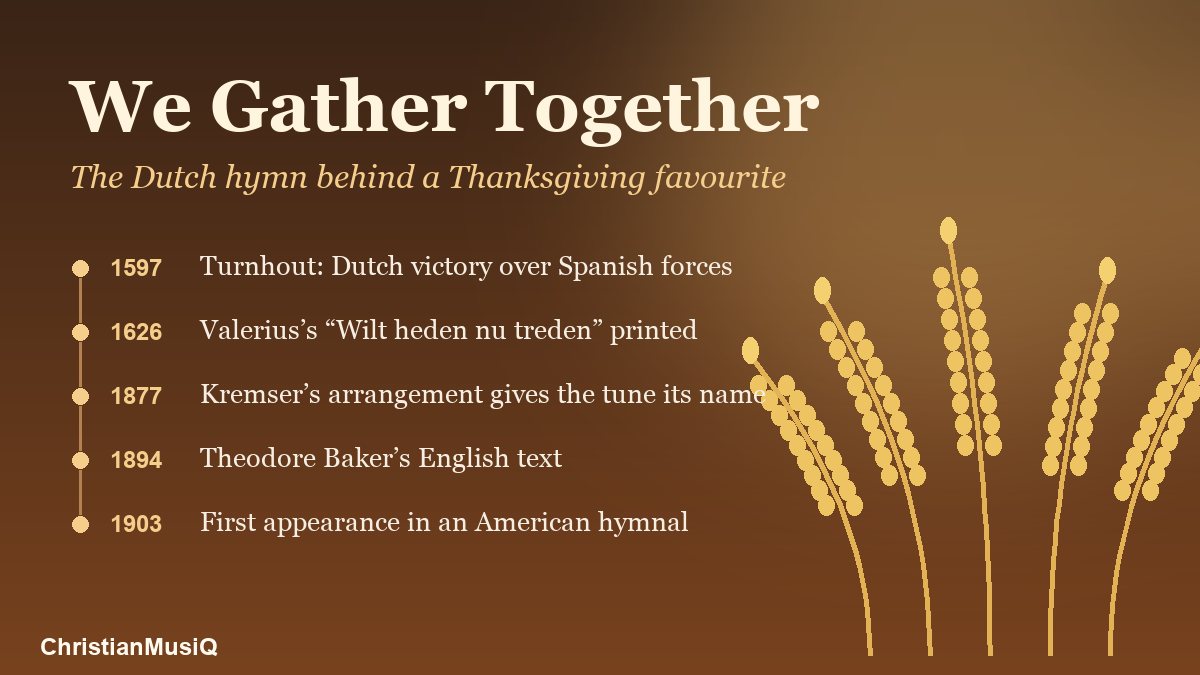
“We Gather Together” is the English version of Wilt heden nu treden, a Dutch song by the poet and composer Adrianus Valerius (about 1575–1625). It was printed in his collection Neder-landtsche gedenck-clanck, usually dated 1626, the year after his death. The usual English text was written by Theodore Baker in 1894, and the familiar tune name, Kremser, comes from Eduard Kremser’s 1877 arrangement of old Dutch folk songs. It reached American hymnals in 1903 and became a Thanksgiving standard in the 20th century. In 2026, Thanksgiving falls on Thursday 26 November, so the hymn’s natural Sunday is 22 November.
The Man Behind the Words
Adrianus (Adriaen) Valerius was not a church musician. He was born in Middelburg in Zeeland around 1575, worked as a customs and toll controller in the town of Veere, married the mayor’s daughter in 1605 and sat on the city council. In his spare years he did something unusual: for roughly thirty years he gathered and edited folk poems and melodies about the Dutch wars against Spain.
That collection, Neder-landtsche gedenck-clanck (“Netherlands Memorial Song”), was published after his death. Reference works usually give 1626 for the first edition. It holds 76 songs, and it did something rare for its time: the songs were printed with musical notation, with lute and cittern accompaniments in tablature, so a family could actually play and sing them at home. The same book contains the melody of the Wilhelmus, which later became the national anthem of the Netherlands.
Why a Hymn About a Battle?
The text behind “We Gather Together” is tied to the Dutch Revolt against Philip II of Spain. The commonly cited occasion is the Dutch victory at Turnhout in January 1597, which is why the song is often dated to that year. Under Spanish rule, Dutch Protestants had been forbidden to gather openly for worship, and that is why “we gather” resonated. It is not a casual line for a harvest table; for its first singers it meant that a congregation could meet.
That context changes how the English lines read. When the first stanza says “the wicked oppressing now cease from distressing,” the Dutch original was talking about a real occupying army, not a general sense of life being hard. It also explains why the song stayed alive in the Netherlands for centuries. Valerius’s collection was studied at home and in church in Zeeland, and the Dutch turned to his songs again during the German occupation of the Second World War.
From Dutch Folk Tune to “Kremser”
Three steps carried the song into English hymnals:
1. 1626: the Dutch text and tune are printed in Valerius’s collection.
2. 1877: the Austrian composer Eduard Kremser arranges it for a collection of old Dutch folk songs. English-language hymnals still name the tune after him, “Kremser.”
3. 1894: Theodore Baker writes the English text we sing today. It is a free adaptation, not a line-by-line translation of the Dutch, which is why Dutch speakers hear a different song.
According to the Hymn Society in the United States and Canada (as summarised on Wikipedia), its first appearance in an American hymnal was in 1903. Its “big break,” in the words of the Society’s executive director Carl Daw, came in 1935, when the Methodist Episcopal Church put it in its national hymnal. In 1937 the Dutch Reformed Church in North America, which had sung only psalms in worship since its arrival in the New World, added hymns for the first time, and “We Gather Together” was chosen as the first hymn in that first hymnal.
It Is Not a Pilgrim Hymn
Popular retellings often connect the song to the Pilgrims, who did spend years in Leiden before sailing in 1620. The dates do not support that link. The Plymouth harvest feast was in 1621, and Valerius’s collection was not printed until 1626. Nothing in the record shows the Pilgrims singing it. Its link to Thanksgiving is much later: American churches began using it for thanksgiving services, especially town and college anniversaries, and by the 20th century it was firmly a late-November hymn.
That is worth saying out loud if you introduce it in church. The real story is better than the myth: a hymn of gratitude from people who had just survived a war, now sung by people who mostly have not.
Using It in Church in 2026
- **Pick its Sunday.** 22 November is the Sunday before Thanksgiving, and the last Sunday before Advent. The first Sunday of Advent follows on 29 November, so “We Gather Together” can close the church year and lead naturally into [five Advent hymns and a four-Sunday plan](/blog/advent-hymns-five-classics-four-sunday-plan).
- **Say something about the first word.** A single sentence, “this song comes from a time when Dutch Protestants had been forbidden to meet openly,” changes how a congregation sings the opening line.
- **Decide what to do with the “wicked oppressing” lines.** They are part of the text. Most hymnals keep them. A short introduction can say they were first about a real conflict, and let people apply them to the oppression they know.
- **Check the arrangement, not the hymn.** The original Dutch text and Baker’s 1894 English words are in the public domain, and so is the old tune. A modern arrangement, a new accompaniment or a recording you did not make may still be protected, so credit it and check the licence. Our [worship song credit and licensing checklist](/blog/worship-song-credit-licensing-checklist) covers what to log.
- **Pair it with a newer song of thanks.** Many congregations follow it with a modern thanksgiving song. A Tamil option on this site is [Nandri Solven En Yesuve](/songs/nandri-solven-en-yesuve), whose title means “I will give thanks, my Jesus.”
If you like hymn histories, the same approach applies to Great Is Thy Faithfulness and How Firm a Foundation. For the wider question of why these older songs keep earning a place, see why ancient hymns still matter.
FAQ
Who wrote “We Gather Together”?
The Dutch original, “Wilt heden nu treden,” is attributed to Adrianus Valerius, published in his collection Neder-landtsche gedenck-clanck. The English words most hymnals use were written by Theodore Baker in 1894.
Is “We Gather Together” a Thanksgiving hymn?
It became one in the United States, but it was not written for Thanksgiving. It began as a Dutch song of thanks after a military victory, and American churches adopted it for Thanksgiving services in the 20th century.
Did the Pilgrims sing it?
There is no record that they did. The collection that first printed it appeared in 1626, five years after the 1621 Plymouth harvest feast.
What is the tune called?
The tune is known as Kremser, after Eduard Kremser’s 1877 arrangement of the old Dutch melody.
Is the hymn in the public domain?
The Dutch text, Baker’s 1894 English text and the old tune are in the public domain. Modern arrangements and recordings may be protected, so check the source before you print or stream them.