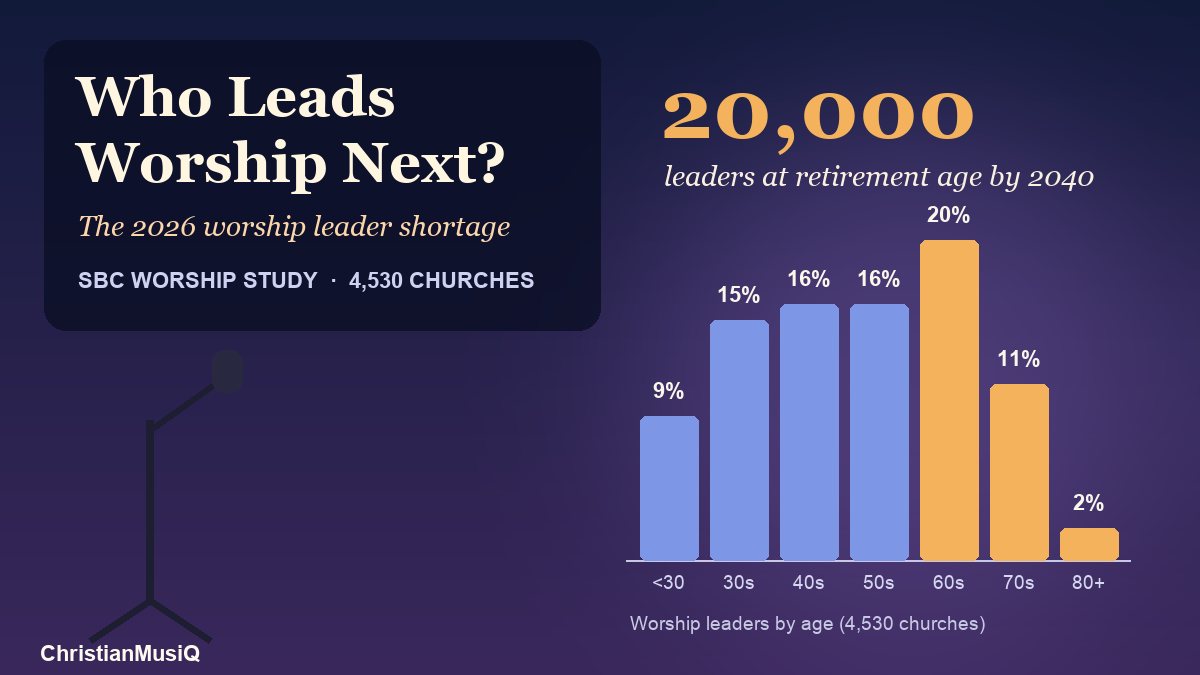
Southern Baptist churches have just received their most detailed picture of worship ministry in almost 90 years, and one number is drawing most of the attention: by 2040, about 20,000 of the people who now lead their congregations in song will be retired or at retirement age. The SBC Worship: Congregations and Leadership Study, released in September 2026, surveyed 4,530 churches. Its findings are now being discussed in a Baptist Press series, on worship-training channels and on state convention blogs.
This guide sets out what the study actually found, what it does not say, and practical steps any church can take this year, Baptist or not, so that it is not left without someone to lead its singing.
Quick Answer
The 2026 study found that 49% of Southern Baptist worship leaders are 50 or older and 33% are 60 or older. The researchers estimate that about 20,000 current leaders will be retired or aged 65 by 2040. In 70% of the churches whose leader will reach retirement age by then, nobody has expressed a call to worship ministry or is being trained to take over. Only 4% of churches have a leadership pipeline, and 51% have no plan for developing worship leaders. The researchers say the answer is local: spot people with musical and spiritual gifts early, give them real chances to serve, and train them inside the church instead of waiting for a seminary graduate to appear.
What Is the SBC Worship Study?
SBC Worship, part of the Worship Initiative, commissioned the study. A committee of worship professors from Southern Baptist colleges and seminaries designed it, chaired by Jonathan S. Welch of Southeastern Baptist Theological Seminary. The 41-question survey ran in spring 2026 and was emailed to more than 30,000 churches and 1,200 denominational leaders. In all, 4,530 churches answered, about 9.7% of the convention, from 49 states, Washington, D.C. and four US territories. The committee reports a 99% confidence level and a 1.8% margin of error.
It is the first comprehensive survey of Southern Baptist worship since 1938. That earlier survey asked churches about their music budgets, their ten most-sung hymns and their order of service. Its results led to a new church music department at the Baptist Sunday School Board, headed by the hymnwriter B. B. McKinney.
Of the churches that answered, 22% average fewer than 50 people in worship, 25% have 50 to 99, 42% have 100 to 499 and 11% have 500 or more. That mix matters, because most of the pressure falls on smaller congregations.
The Numbers Behind the Shortage
There is good news too. About 61% of churches name strong support from the senior pastor as a top strength, 54% report no significant conflict over musical style in recent years, and 44% list joyful congregational singing among their strengths.
What the Study Does Not Say
Three cautions are worth keeping in mind before quoting these figures.
It covers one denomination. The data come from Southern Baptist churches, almost all in the United States. Other denominations and other countries may look different, and the study gives no figures for them. Even so, many congregations will recognise the pattern: one faithful volunteer has led for decades, and nobody stands behind them.
It is a baseline, not a full explanation. Welch calls it “a baseline diagnostic” and says more research is needed to pin down the causes. SBC Worship plans a follow-up survey in spring 2027 and hopes to share the results at the 2027 SBC Annual Meeting.
“Retirement age” does not mean gone. The 20,000 figure counts leaders who will be retired or aged 65. Many keep serving well past that. The real risk is a sudden vacancy with nobody prepared to step in.
Why the Gap Has Grown
The research team offers a few reasons. Andrew Lucius of Charleston Southern University told Baptist Press that churches have treated universities and seminaries as the main place to train their leaders, instead of developing young musicians themselves. Expectations of the role also vary widely from church to church, and Welch has called for conversations that “recalibrate expectations for what the role really is.” Lucius adds that the shortage is not unique to music: other church leadership roles face the same strain.
How Your Church Can Respond This Year
The researchers’ own conclusion is that the solutions will come from local churches. Here is a practical plan that works for a congregation of 40 or of 400.
1. Name the risk. Ask the questions the study raises. Who leads worship today? Who would step in next month if they could not? Is anyone being trained? Write the answers down and share them with your pastor and church leaders.
2. Look for gifts, not finished leaders. A future worship leader is rarely ready-made. Look for teenagers and adults who sing in tune, play a little, turn up reliably and love the church. Welch’s question is the right one: “Are we identifying those gifts and actually giving them opportunities to serve in those meaningful ways in the church?”
3. Build a simple pathway. A pipeline does not need a programme. Three stages are enough. Serve: sing on the team, run slides or work the sound desk. Share: lead one song in a set, then a full set with the current leader beside you. Step up: plan and lead a Sunday, then talk it through afterwards. Our guide to leading worship in a small church covers the basics on stage, and how to build a worship set gives a trainee a structure for planning.
4. Teach the skills at home. With 68% of current leaders holding no related degree, most learned on the job, and the next generation can too. Run a monthly chord night with our beginner’s guide to worship chords, invite trainees to every rehearsal, and pass on practical habits such as choosing keys, planning transitions and crediting songs. Our worship song credit and licensing checklist makes a good handout for the admin side.
5. Start younger. Only 26% of churches have young musicians serving, so the earliest step is simply letting children and teenagers sing and play in real services. Our list of worship songs for kids is a place to begin.
6. Plan for small-church reality. If you have no instrumentalists, unaccompanied congregational singing, a single guitar or good backing tracks can carry a service while someone is trained. Our worship planning guide for small churches has more ideas for limited teams.
7. Disciple, don’t just recruit. SBC Worship argues that the deeper need is to recover worship as spiritual formation rather than “consumption or production.” A trainee who only learns songs may burn out; one who is being discipled is more likely to last. Pair each trainee with a mentor, pray together, and talk about why the church sings, not only what it sings.
8. Care for the leader you have. The study names isolation and burnout among worship leaders as a real problem, and only 43% of churches describe their worship team as unified and loving. Thank your current leader, give them regular breaks, and make training a successor part of their ministry rather than a sign that they are being pushed aside.
FAQ
Is there really a worship leader shortage?
Among Southern Baptist churches, the 2026 study says yes. Nearly 1,900 churches that normally have a worship leader are without one now, and about 20,000 current leaders will be retired or at retirement age by 2040. In 70% of the churches facing that retirement, no successor is being trained.
Who carried out the 2026 SBC worship study?
SBC Worship, part of the Worship Initiative, commissioned it. A committee of worship professors from Southern Baptist schools, chaired by Jonathan S. Welch of Southeastern Baptist Theological Seminary, designed the survey, and 4,530 churches took part.
Where can I read the full report?
The report can be downloaded free from the study page at sbcworship.com/study-2026, linked in the sources below.
Does a church need a paid worship leader?
No. Many churches, especially small ones, are led by volunteers or bivocational leaders. What the study points to is the need for a plan: someone being trained and ready to lead, whether they are paid or not.
Sources
SBC Worship: Congregations & Leadership Study 2026
Baptist Press: Great need for worship leaders coming very soon, church survey reveals
Baptist Press: Survey a good start, but churches hold the solution, worship researchers say
Renewing Worship NC: Diving Into the SBC Worship Congregations and Leadership Study